Why Testing Scheduling Deep Reasoning Matters
As we see these new frontier models emerge, it is worth highlighting why benchmarking deep reasoning capabilities in scheduling is so important:
The Universal Baseline Across All Use Cases: Deep reasoning is the foundational orchestration capability that everyone relies on across all applications. Whether a model is analyzing a schedule, parsing a contract, or solving a logistical problem, it defaults to this underlying zero-shot reasoning, especially when it lacks access to external data, live feeds, or third-party plugins. When vendors and developers build commercial scheduling AI tools, they are fundamentally building on top of this baseline. If the core scheduling reasoning is flawed, any solution built upon it will ultimately struggle.
Impact on Scheduling Document Analysis and Reporting: Strong scheduling reasoning is not just about abstract the math or logic; it drives everyday practical applications. For tasks like analyzing complex project documents or drafting schedule narratives, a model that excels in native reasoning about scheduling has a much higher probability of delivering higher first-pass accuracy, maintaining strict context, and requiring fewer prompt iterations from the user.
The Cost vs. Performance Trade-off
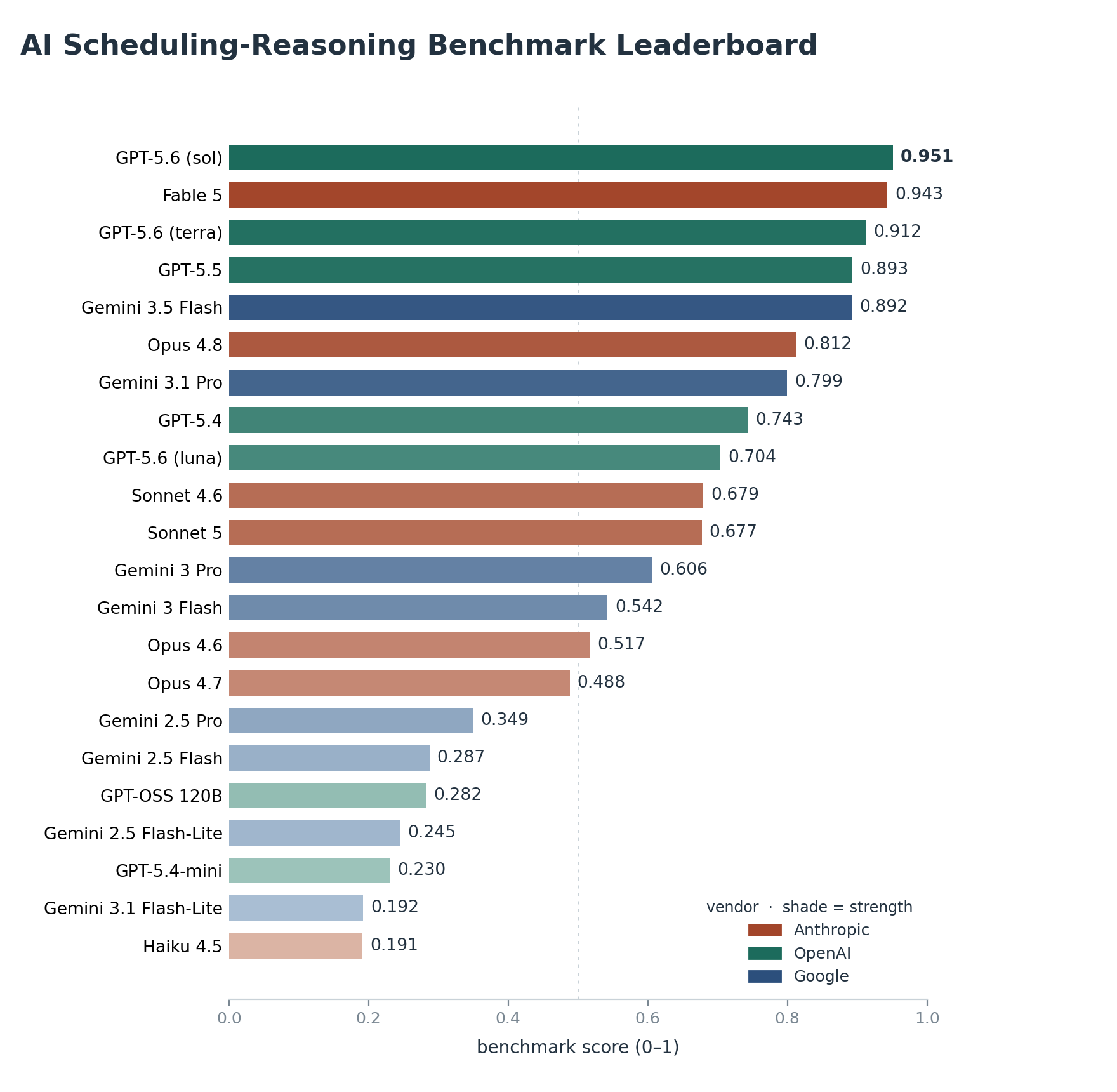
One of the most striking results is what the leaderboard reveals about efficiency. Gemini 3.5 Flash (0.892) delivers near-flagship performance, hovering right behind the heavyweights GPT-5.6 (sol), Fable 5, and GPT-5.6 (terra) and it does so on a lightweight "Flash"-class model at a standard, mid-level reasoning-effort setting. For real-world applications where cost and inference latency are critical, that is an incredibly compelling trade-off.
The contrast with GPT-5.5 (0.893) makes the point. It lands at essentially the same score, but only at its highest reasoning-effort setting; dialed back to a comparable mid-level effort it falls to 0.758. In other words, a lightweight model matched a flagship-tier run at a fraction of the compute, a useful reminder that headline accuracy and real-world cost-efficiency are not the same axis.
What's Next?
More results will follow as soon as they are ready. In the meantime, I would love to hear from the community:
- Are you currently using any of these models for your scheduling workflows?
- Do you know which model is embedded under the AI-powered solution that you are using? and can you choose the model?
- What other open-source or commercial models would you like to see added to this benchmark? (some of them failed already to produce results)
- Would you be interested in seeing specific specialized tests next, such as Forensic Scheduling? Let me know!
------------------------------
Zine Eddine Zouaghi
zine.zouaghi@gmail.com------------------------------